The Ashes: Australia to win … and here are 5 reasons why

Tomorrow night at 8pm the Ashes series between the old foes, Australia and England, will commence. Everyone, including most Australian fans it seems, think England is going to win. I disagree … in fact I vehemently disagree! Here are my five reasons why I believe Australia will win back the Urn:

England are smug and think they are going to win:

Everything we, as fans, have heard from the pundits from the old dart is that this is the worst Australian team to travel to England since Federation and that the Australians have no chance of winning. The last time we heard such punditary from those apparent experts was in 1989 when Australia travelled to England with a squad the performance of which hinged on a new opening pairing, an allrounder without a hundred in 5 years of test cricket, an inexperienced ‘keeper and a bowling attack that mixed some old stagers (Alderman and Lawson) and an under pressure spinner (Hohns). Sound familiar? The main reason I think we will win is because the English think they will win and that approach has failed them in the past.

Is Australia’s form that bad?

OK: it is obvious that Australia’s form in Test Cricket coming into this series is not great. A 4-0 loss to India in India does not make for pretty reading. However is England’s form any more compelling? Yes they defeated New Zealand at home 2-0 but before that they did not manage a win in a three test tour against New Zealand away. All due respect to the New Zealand team that is hardly a sparkling form line itself. Before that both teams lost a series the South Africans. Of course England did perform brilliantly in India it must be conceded.

Swann v Lyon

I have written in detail about the strengths of Nathan Lyon and the fact that he is a key component in this Australian team. On the other side of the fence is Graeme Swann. Let me be clear at the outset here: I think Swann is world class. That said, his record against Australia is less than impressive. In the two series between the teams he has participated in he has taken 29 wickets at an average of 40. Last time Australia was in England he returned a less than impressive 14 wickets at 40.50 with an economy rate of 3.32 per over which is 1.22 per over higher than his economy rate for his career. Australia needs to attack Swann: England have been at their best in recent times when they have him holding up one end and drying up runs while their fast bowlers rotate up the other end. Despite Australia’s poor form against spin in India, if they attack Swann and hit him off his game that will go a long way to a win. We have to get out of the mindest that he is anything like the Indian spinners: he is not and these are not Indian wickets!

The era of Boof:

Darren Lehmann’s installation as coach of the Australian cricket can only be a positive. Simply put, Lehmann is a coach who lifted the Queensland Bulls Sheffield Shield team to two finals in two years with a player list that Cricket Australia does not deign to believe contains a test match player. Lehmann knows what it takes to win and has a history of building harmonious high performing units which it was clear the old regime was not. He is also a coach that presents as getting the best out of Shane Watson who will have a large part to play in Australia’s possible success.

Psychological warfare:

Jimmy Anderson has come out during the week and suggested that he has added sledging to his armoury. Australia has seemed to try to bring such warfare to recent performances in a somewhat hamfisted and unsuccessful way. The “Davey Warner” method of sledging and physical confrontation MUST stop! Australia needs to take a leaf out of the book of the 1989 and 1993 teams: when (if) they get on top in any of these tests and in the series they need to put the metaphorical foot on the throat of England and press down hard. I always remember the story of Allan Border in the 1993 series batting into a 3rd day to push Australia’s score over 650 just to “add to their mental disintegration”. If Australia win the mental battle they will win the series.

There is only one sleep to go before the Ashes start: it is time for Australian fans to mobilise behind our team. The fact is we can win and I think we will.

I have my supplies for the series at the ready (coffee, protein shakes and red bull), the batteries are about to be taken out of the remote control and I have banked up a heap of extra sleep to get me through. It is go time people! Let’s get our urn back!
Super Rugby: who will be playing in Week 1 of the finals?

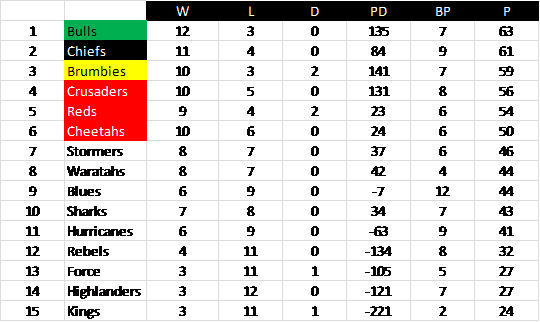
There is one round to go before the finals and as matters presently stand the Super Rugby table looks like this:

Super Rugby

Given that the Cheetahs have a bye in round 20 they are guaranteed of a spot in the finals and thus all other of the other teams not already in the top 6 are simply playing for pride this week. That said they make up of the final six is by no means final and there are a number of fixtures that could have a large impact who is playing whom in the first week. Those games are:

Crusaders v Hurricanes
Blues v Chiefs
Waratahs v Reds
Force v Brumbies
Stormers v Bulls

Obviously at this juncture it is important to reflect on how the qualification process for the finals works in Super Rugby. Rule 3.5.2 of the Tournament rules provides:

Six teams will qualify for the Finals Series at the conclusion of the Regular Season as follows:

a) Conference Winners: the team in each of the AC, NZC and SAC with the highest number of competition points will be the Conference Winner for the respective Conference and will qualify for the Finals Series.

The three Conference Winners will receive a Finals Series Ranking as follows:

(i) The team with the highest number of competition points will have a Finals Series Ranking of 1;
(ii)The team with the second highest number of competition points will have a Finals Series Ranking of 2;
(iii) The team with the third highest number of competition points will have a Finals Series Ranking of 3.

b) Wildcard Teams: the remaining three Finals Series places will be allocated to the three non-Conference Winning teams with the highest number of Super Rugby table competition points regardless of the Conference in which the team plays. The three Wildcard Teams will receive a Finals Series Ranking as follows:

(i) The team with the highest number of competition points will have a Finals Series Ranking of 4;
(ii)The team with the second highest number of competition points will have a Finals Series Ranking of 5;
(iii) The team with the third highest number of competition points will have a Finals Series Ranking of 6.

With so many games having any impact on the ultimate positions of those teams in the top six, it is impossible to forecast all of the available permeations. I know this because I put my meagre skills in excel to the task of running such a model and failed dismally. That said: there are some outcomes that it is quite simple to map:
• The Cheetahs will definitely be travelling next week. They will end up on 54 points with a points differential of plus 24. The best they can finish is 5th which will occur if the Reds loose to the Waratahs and do not pick up a bonus point. If the Reds draw or win or lose but secure a bonus point the Cheetahs will finish 6th.
• A loss for the Reds will see them finish 6th on the table. A bonus point loss or a draw will see the Reds finish 5th regardless of the result of the Crusaders game against the Hurricanes. For the Reds to end up finishing 4th and hosting one of the qualifying finals next week they need, simply, the Crusaders to loose and for them to win. If the Crusaders win against the Hurricanes they will end up 5th in any non-loss scenario.
• The Crusaders, at this stage, have at least 5th place locked up and they will only end up there if the Reds win and they lose. A Crusaders draw or win against the Hurricanes will lock up 4th spot at least. The plight of the Crusaders, however, gets very interesting if they win against the Hurricanes with a bonus point. This result would place them above the Chiefs for the NZ conference on for and against. Thus if the Chiefs fail to get any points against the Blues there is a possibility that the Crusaders could win the conference.
• The Brumbies locked up the Australian conference some weeks ago. Even if they were to loose without a bonus point, the Reds would need to defeat the Waratahs by at least 100 points to jump them on the table. In play though for the Brumbies is the prospect of having the first week of the finals off: that scenario could arise if either of the Chiefs or Bulls loose and the Brumbies win. Indeed, there is a possibility that the Brumbies could end up with home field advantage throughout the finals if both of the Bulls and the Chiefs loose.
• The Chiefs only need to secure a point from their fixture against the Blues to secure the New Zealand conference. As I have noted above there is a mathematical chance that the Crusaders could jump over them and take the New Zealand conference. If the Chiefs were to loose but gain a bonus point or were to draw against the Blues there is a prospect that they could finish 3rd and thus have to play in a qualifying final next week if the Brumbies were to win. Of course, there is also the prospect that the Chiefs could finish the top of the table if they win and the Bulls loose.
• The Bulls presently lead the competition and are in the box seat for home ground advantage for the whole of the finals. That said, they still could finish 3rd overall and have to play in the first week of the finals if they loose to the Stormers and do not secure a bonus point and both the Chiefs and the Brumbies win. If the Bulls win however, or draw and the Chiefs win by fail to garner a bonus point, the Bulls will finish atop the ladder. Of course the other scenario that presents itself here is that the Chiefs win but the Bulls loose. In that scenario the Chiefs would go top and the Bulls would end up 2nd.

All in all, these permeations set up for a fascinating last round of Super Rugby this season.

So once all of the final rankings are determined, what happens in the finals? Rule 3.6 of the Tournament rules is instructive and provides that the teams for the week 1 qualifiers will be determined as follows:

Match A – Rank 4 v Rank 5
Match B – Rank 3 v Rank 6

The higher ranking team will receive home ground advantage which is why the Cheetahs only have the prospect of travelling in week 1 of the finals. As matters stand presently any of the conference winning teams could end up hosting a final in final’s week one and either of the Crusaders or the Reds could have the opportunity to host the other finals.

Is anyone else excited about the week of Super Rugby that awaits us?

The Ashes: England Squad Announcement

Here is the English squad for the first Ashes 2013 test match at Trent Bridge:

A Cook (c), J Root, J Trott, K Pietersen, I Bell, J Bairstow, M Prior, T Bresnan, S Broad, G Swann, S Finn, J Anderson, P Onions

No real surprises here for the English. Obviously deep down I am hoping for a repeat of 1989 when the Poms used 39 players but doubt that is going to happen.

Bring on Wednesday!

The Lions Tour: what did we learn about the Wallabies?

Well the Lions your has ended with the pummelling many fair minded fans expected at some point during this series. This is a time to reflect on the Australian performance and learn from it with an eye on the upcoming Rugby Championship and the next World Cup. Here are the 5 key learnings, for mine, arising from this series:

1. Australia MUST have a better preparation than a 3 week training camp before the first test of a series. Stopping the players from playing for their franchises in the weeks preceding the first test was a mistake with the Wallabies often looking disjointed and unorganised in that first test.

2. Ben Mowan is a future captain of Australia. Has there been a more composed and purposeful start to a career in a Wallabies jumper than that of B Mowan? What a brilliant commencement to a career: was in everything and never took a backward step.

3. James O’Connor is not a test fly half. Yes he set up our only try in the second test and yes he scored in the third test. That does not mean he gets a pass mark for his performance in this series. O’Connor is a centre or a winger and he played like one.

4. Jesse Mogg is Chris Latham reincarnate. Mogg’s long period on the field after Folau’s injury was enough for me to be certain that Mogg’s booming left boot and excellent positional play are a must for future test matches. He must be our fullback.

5. James Horwill is an innovative captain but MUST learn to take the points. All too often this series the Wallabies were in attacking position and without a penetrative attack and yet still Horwill chose to go for tries rather than easy points on offer. This must stop.

I am not going to talk about Cooper or Deans or Beale or the scrum. These are all issues that are obvious. The lessons above transcend those obvious issues.

The Wallabies were competitive but never really threatened. Some dark days are ahead if the Wallabies do not learn from this!

Shumpty’s Punt: Weekend Multi plus Horse Racing

Have had a close look at the form for this weekend and here are my bets. As always please gamble responsibly and only bet what you can afford.

Multi Bet:

Leg 1: Brisbane Lions to defeat the Gold Coast Suns in the AFL ($1.55)

Leg 2: Hurricanes to cover the line against the Highlanders (-9.5 points) in Super Rugby ($1.90)

Leg 3: Canberra Raiders to cover the line against the NQ Cowboys (-4.5 points) in the NRL ($1.92)

Leg 4: Bulls to cover the line against the Sharks (-6.5 points) in Super Rugby ($1.90)

Leg 5: Nico Rosberg to be on the podium in the German Grand Prix ($2.50)

All up this multi will pay $26.85 for every dollar invested (prices are from Sportsbet.com.au) and I have invested $25.

Horse Racing:

Eagle Farm:

Race 3 Number 10 Avaladyluck (Win)
Race 7 Number 3 Griffon (Each Way)

Rosehill:

Race 2 Number 7 Rebel Dancer (Each Way)

Flemington:

Race 5 Number 3 Riziz (Win)

Good luck and good punting!

The Ashes: We know who the openers are but who bats number 3 for Australia?

Darren Lehmann is off and running as the coach of the Australian cricket team and has started his “reign” by confirming before the last trial game before the 1st Test that Shane Watson and Chris Rogers will be the opening for Australia come 10 July. That decision means that neither of the incumbents from the last test match played by Australia, David Warner and Ed Cowan, will be retaining their former positions in the team.

Obviously, the Australian cricket team is in a state of flux with the appointment of a new coach and the only secure places in the batting order seemingly the openers (now that their positions have been confirmed) and that of the captain, wherever he decides to bat. That means that the number 3 position (assuming M Clarke doesn’t bow to the pressure of I Chappell and bat there) is up for grabs for the following contenders: P Hughes (the incumbent), D Warner, E Cowan and U Khawaja.

I think it would be fair to say that the issue of “who bats number 3?” has oft been a vexed question in Australian cricket. Regularly the best batsman in the team has been tapped on the shoulder to be the number 3 batsman. In this regard one only needs to look at where players like Don Bradman, Ricky Ponting and Greg Chappell spent the bulk of their careers in the Australia team. The only time that that standard does not seem to hold true is when the captain is also the best batsman in the team and declines to bat in that position. The eras of Allan Border and Steve Waugh are instructive in that context.

So if the best batsman in the team is the captain and declines to bat at number 3 what style of batsman should be invested with the obligation of going in at the time the first wicket goes down. In my opinion one only needs to consider the efforts of David Boon to come to the conclusion that the style of batsman that ought be given the role of number 3, in the absence of the best batsman in the team (which is not to say that Boon at points was not that batsman but I think it would be fair to say that when he started batting at 3 he was not), is an established opener. With David Boon at number 3 from the 1989 Ashes tour (bearing in mind that he had batted at 3 before this point) Australia was blessed with a batsman who had spent some 20 test matches at the top of the order for almost 1,500 runs at an average of 36.85. More to the point, in Boon Australia possessed someone who was extremely experienced in going in against the new ball such that if he was in early he was used to it.

Now at this point I am sure many of you are saying: so? We have Phil Hughes batting at number 3 for Australia and he is a former opener for his country so surely, based on your own measure, Hughes must get the gig? Simply though I do not believe that Hughes is good enough form to play the role that D Boon did for Australia for all of those years post 1989 and particularly not so for an Ashes series. Hughes is, after all, in his third coming as an Australian test cricketer and in this coming has been pigeon holed as a number 3 batsman. In his 7 test matches back in the test team he has scored 380 runs in 13 innings at an average of 29.23 and is without a hundred in that span. That is simply not good enough and I am of the view that a change needs to be made for the first test.

So which of the other contenders should be selected in Hughes’ place (if that change is made). I suspect that Darren Lehmann would be looking to avoid having a change at number 3 that would see another player who has not been in the test team of recent times in the team so that, unfortunately, counts out Usman Khawaja. Whilst I think he is a player of the future he has not done enough in my view in the preliminary games to make his selection a foregone conclusion. With avoiding too much change in mind I think Lehmann will avoid using Khawaja at number 3 on 10 July.

That makes the race for the other position in the “engine room” (as D Boon used to call it) between Ed Cowan and David Warner. Have there been two more contrasting styles in Australian cricket than these two players? As good a starting point as any is to consider their records over the last 12 months:

Cowan Warner

All told then there is not much difference between the two records save that Warner has scored more fifties and Cowan occupies the crease longer. Who should Darren Lehmann go for then come 10 July? Importantly, both records are largely commensurate with that of David Boon before he became Australia’s first choice number 3 batsmen albeit the strike rate of Boon is closer to that of Cowan than that of Warner.

I think it is important here to also consider the preparation of both players in advance of this first test. I have written earlier about trials and tribulations of David Warner this year. In raw cricket terms his lead in to the first test has consisted of playing in the IPL 20/20 competition, 2 games in the Champions Trophy and then a long stint on the sidelines (and no doubt practicing in the nets) as he serves his suspension for punching Joe Root.

Conversely, Ed Cowan has spent the start of the English summer playing first class cricket for Nottinghamshire. By the end of Australia’s current trial game against Worcestershire he will have played 9 first class games in English conditions. His form for Nottinghamshire in his 7 games for them has been solid without being flashy scoring 478 runs at 43.45. A final key point on Cowan’s run in to the first test is, that if selected, he will be playing on his home ground (for Nottinghamshire) Trent Bridge.

A final consideration here is the style of players Cowan and Warner are: can anyone cogently argue that they would feel more comfortable with Warner walking out to the crease with the score on 1/0 than Ed Cowan? I, for one, shudder at the thought of Warner coming to the crease with the score one down for not many.

All of the foregoing considered then, it must be pretty obvious the way I am leaning. If Phil Hughes is not selected, as I believe he ought not be, then I am firmly of the view that Ed Cowan should be Australia’s number 3 for the first test at Trent Bridge. The statistics, the lead in form and the stylistic considerations all point that way.